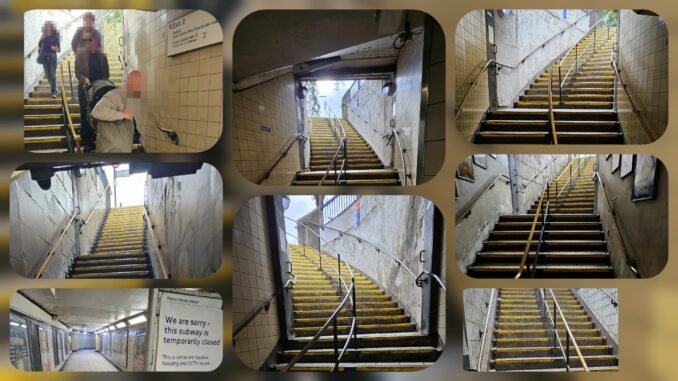
Manor House station has no step-free access. This will surprise nobody who has tried to get a pushchair, a suitcase or a walking frame down to the Piccadilly line, and it will surprise rather fewer people than it ought to, because the station has been this way since 1932 and most of us have simply learned to work around it.
It is nonetheless worth asking why, and whether the answer has to stay as it is.
What we are told, and what we can establish
The received wisdom, which I have heard more than once and which WDCO has, I am told, met in correspondence with Transport for London in the past, is that step-free access at Manor House is not possible. I have not yet seen that correspondence in a form I could quote, so I shall not quote it. What I can say is that I have found nothing published by TfL that says the station has been assessed and ruled out. There is a difference between “impossible” and “not yet looked at in any depth”, and the published record is, so far, more consistent with the latter.
The second piece of received wisdom is that Manor House sits some way down TfL’s list of priorities on the Piccadilly line. The published picture is a little starker than that. TfL’s most recent announcements of stations to be studied or designed for step-free access do not include Manor House at all. On the Piccadilly line, Alperton, Arnos Grove and Eastcote are in design, and Turnham Green is under feasibility assessment. Five further stations (Barkingside, Brent Cross, Preston Road, Queensbury and Totteridge & Whetstone) were added for feasibility work in March 2026, chosen from a longlist of thirty. A Freedom of Information response listing that longlist, as I read it, does not include Manor House either. Being a long way down a queue implies that one is in it. On the evidence available, we are not yet in it.
Why this station is awkward
The difficulty most often cited is the site. The station sits beneath the junction of Green Lanes and Seven Sisters Road, with entrances at the street corners, a ticket hall one level down, and the platforms a good deal lower, reached by escalators. Anything that adds a lift has to find a shaft’s worth of space at three levels, in or beside a junction that carries a great deal of traffic and a great many buried services, and that is shared between two boroughs. None of that is trivial, and I would rather say so than pretend that a lift is merely a matter of will.
It is, though, a different thing from impossible. TfL’s own feasibility work, as described for the stations it has recently examined, turns on platform depth, available space for lifts and construction complexity. Those are engineering questions with engineering answers, usually expensive ones. Hackney Council’s draft Manor House Area Action Plan, an older document whose date I have yet to establish, records that “options for a new lift access to the ticket hall/platform” should be examined, and that TfL had identified a preferred lift location on the north-east corner of the junction. If that is still the case, someone at TfL has already looked at the ground, at least in outline.
A precedent at Greenford
There is a comparison to hand that deserves more attention than it seems to have had. In October 2015, Greenford station on the Central line became step-free by means of an inclined lift, the first of its kind in the United Kingdom and, at the time, the 67th step-free station on the Underground. The lift runs on a slope alongside the escalator, which avoids excavating a conventional shaft and makes use of space already occupied; TfL described it as cheaper to install and to run than a standard lift, and the local councillor who welcomed it said it had been delivered “at a fraction of the original prices considered”. It was not an effortless success, since the project had been halted in 2009 before being revived, but it was built.
The relevant point is the size of the station it was built for. TfL counts passengers at the gate, by taps in and taps out, and publishes annualised totals of entries and exits for every station. On those figures Greenford recorded about 4.2 million in 2019, the last full year before the pandemic, and about 3.1 million in 2025. Manor House recorded about 8.6 million in 2019 and about 5.4 million in 2025. In every year since 2017 other than 2020, when the count fell within the second lockdown, Manor House has been used by between roughly one and three-quarters and twice as many people as Greenford. The Greenford lift was judged worth building for a station with, on any of these measures, about half the traffic of ours.
It would be unwise to push this too far. Footfall is one of several things TfL weighs, alongside cost, deliverability and the availability of outside money, and the Greenford figures say nothing about what a lift would cost at Manor House. I have also not established how the depth of the two stations compares, and an inclined lift suits some escalator shafts better than others. One commentator has suggested that converting one of Manor House’s three escalators might be possible; that is a suggestion from outside TfL, and the purpose of a feasibility study is precisely to find out. What the comparison does establish is narrower and, I think, sufficient: a design that TfL has already used, at a station with about half the traffic, has not been tested at ours.
There is a second question that the figures cannot answer for us. It is often said that a station newly made step-free attracts passengers who had previously avoided it: parents with pushchairs, older people, those with luggage, and wheelchair users. That is plausible, and at Manor House one would expect the airport traveller and the resident of Stamford Hill, which has no Tube station of its own, to figure among them. I have seen a large percentage increase quoted for Greenford, but the TfL counts I have examined begin in 2017, two years after the lift opened, so they cannot show what happened at the time. They do show Greenford falling from 4.5 million in 2017 to 4.2 million in 2019, which is not the pattern of a continuing surge. TfL will hold the counts for the years either side of the opening, and for every other station it has made step-free, which is why they appear among the requests below.
A candid word on trend is also due. Use of both stations is down on 2019: by about 37 per cent at Manor House and 26 per cent at Greenford, against 19 per cent for the Underground as a whole. I do not know why Manor House has fallen further than the network, and I would not claim that the absence of a lift explains it, since Greenford, which has one, has fallen too. The figures are better treated as a question than as a conclusion, and it is one TfL should find at least as interesting as we do.
Two questions, not one
It helps, I think, to split the request in two, because the answers may differ considerably in cost and difficulty.
First: step-free access from the street to the ticket hall. This is the shallower of the two problems and would, on its own, be of some use: it would open the ticket hall, and its passages, to people who currently cannot reach them. It would not, by itself, get anyone to a train.
Second: step-free access all the way to the platforms. This is what most people mean by step-free access, and it is the harder and dearer problem, since it involves the full depth of the station and the arrangement of the escalators and passages beneath. It is also the only version that makes the station genuinely usable by a wheelchair user.
Asking TfL to examine both has the merit of letting them tell us where the difficulty actually lies. If the ticket hall is readily achievable and the platform level is not, we shall at least know that, and the argument can then be about the second stage rather than about everything.
Who pays
TfL has been explicit that it funds the feasibility studies itself, but that delivery “will be dependent on TfL’s future funding position, with deliverable schemes prioritised where there is significant third-party funding available”. A scheme at West Hampstead received around £10 million from funding linked to adjacent development. The practical implication, unwelcome though it may be, is that a case for Manor House is stronger if it arrives with some idea of where money might come from: the redevelopment of sites around the junction, the Section 106 and Community Infrastructure Levy arrangements of Hackney and Haringey, and whatever the regeneration at Woodberry Down can properly be asked to contribute.
What we propose to ask
Nothing elaborate. We intend to write to TfL asking that they:
- confirm whether Manor House has ever been the subject of a step-free feasibility study and, if so, when, and with what conclusion;
- examine, or re-examine, two options: step-free access to the ticket hall, and step-free access to the platforms;
- tell us what criteria would need to be met for the station to be added to the feasibility programme;
- say whether the inclined lift used at Greenford has been considered for Manor House and, if not, why it would be unsuitable;
- provide entry and exit figures for Greenford, and for other stations made step-free in recent years, for the years before and after the work (the published series I have seen begins in 2017); and
- indicate what contribution from other parties would materially improve the prospects of a scheme.
If anyone has a record of earlier correspondence with TfL on this subject, or has a view on the junction that comes from daily use rather than from a plan, I should be glad to hear from you.
Sources: TfL press releases on step-free access (August 2024 and March 2026); TfL Board paper on step-free access (July 2023); Freedom of Information response on stations under consideration for step-free access (WhatDoTheyKnow); draft Manor House Area Action Plan, London Borough of Hackney; TfL press release on the Greenford incline lift (October 2015); TfL annualised station entry and exit counts, 2017 to 2025 (figures are estimates annualised from typical autumn days, and TfL’s method has been revised more than once, so year-to-year changes are approximate).
Leave a Reply